Unboxed Manufacturing: The Paint Shop Problem Nobody’s Solving
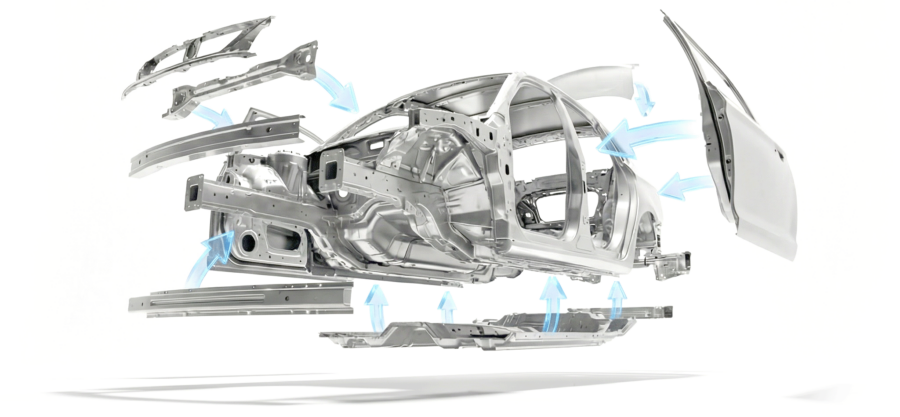
Tesla introduced unboxed manufacturing at Investor Day 2023. The concept: stop building cars on a single linear line. Instead, build six sub-assemblies in parallel — front, rear, left side, right side, underbody, closures — and join them at the end. The promised payoff: 40% less factory space, 30% lower cost.
One critical detail got glossed over. What happens to the paint shop?
The assumption that breaks
Every automotive paint shop operates on one assumption: you receive a complete body-in-white. You dip it. You bake it. You coat it. The body stays intact through every process step.
Unboxed manufacturing removes that assumption. If you’re building a car in six modules, when exactly do you paint them? Every option creates problems:
Paint modules separately. You need new fixtures for every module type. E-coat tank dimensions won’t work. Module edges lack corrosion protection at join points. And color matching becomes critical — base coat applied on Tuesday won’t match Thursday’s batch, even with the same formula. For metallic and pearl finishes, batch-to-batch variation is visible at join lines.
Join first, then paint means all parallel work funnels into one bottleneck: the paint shop. And you’re pushing pre-installed wiring and interiors through chemical baths and 180°C ovens. That destroys components and paint quality. [PM1]
Hybrid approach. Paint some modules, protect join areas, assemble, then seal and topcoat. Possible — but now you’re running multiple paint processes with different cycle times. Module assembly can’t start until the slowest component finishes its oven cycle.
What’s actually happening
Tesla’s latest patent filings (WO/2024/182432) describe pre-treating modules with e-coat and paint before final assembly — essentially choosing option one. But their Austin and Berlin plants still reportedly paint traditional body-in-white assemblies before module installation.
Why? Because the core technical challenges remain unsolved:
E-coat requires complete immersion — how do you dip a front module with pre-installed HVAC and wiring? Individual modules have different thermal mass, meaning different oven cure profiles for each geometry. And join-line sealing — normally applied after paint — can’t happen when those joints don’t exist yet.
BMW, Mercedes, VW, and Stellantis are watching. Some are experimenting with partial modularization — pre-assembling interiors, fitting closures later — but keeping the body structure intact through the paint shop. They capture some efficiency without blowing up the process that works.
The real question is takt time
Traditional paint shops run 40–60 jobs per hour of complete body structures. That rhythm drives every downstream process. Tesla’s factories target 500,000+ units annually. Traditional OEM paint shops handle 250,000–350,000.
Unboxed manufacturing promises to solve the assembly bottleneck. But if module-based painting requires different tank dimensions, separate oven profiles per module type, new fixture systems, and join-line processes that don’t exist yet each adding cycle time and variability — you haven’t eliminated a bottleneck. You’ve moved it.
If a paint shop processes 500,000 BIWs per year and each body is split into four modules in an unboxed approach, the paint shop suddenly needs to handle 2 million units at a similar takt time. How will this be possible? Several OEMs around the world are already developing concepts to address this. We at ESS are proud to be part of some of these efforts, enabling upfront virtual assessment before any hardware changes are made.