PaintIQ for Plastic Parts
Paint plastic parts right.
With 15.6% less material.
Before production starts.
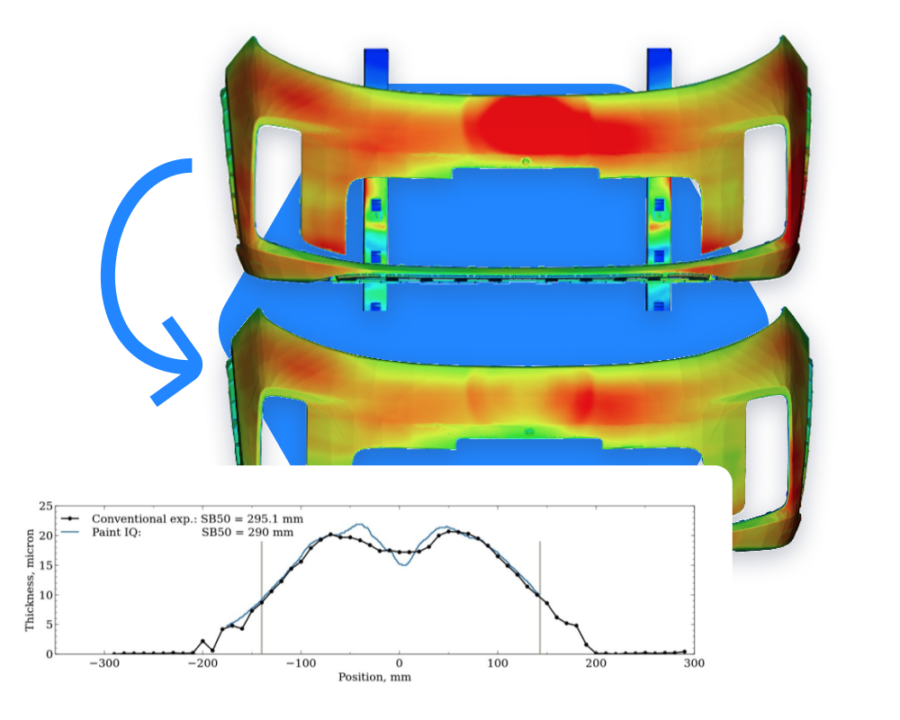
Virtual set-up: digital twin shows film build long before production, at >85% accuracy
Virtual commissioning: 0 trial parts for new robotic paths
Optimization, material: 15.6% savings, proven in production
Optimization, takt time: optimized in the same pass, without trading film build
Plastic is not steel with softer settings. Five problems cost plastics paint shops material, time and trial parts. PaintIQ resolves each of them before production starts.
| The pain | How PaintIQ resolves it |
|---|---|
| ~60% of paint becomes overspray. Transfer efficiency on bumper spray guns is around 40%: PP and PP+EPDM are non-conductive and the field depends on the grounding fixtures. | 15.6% material savings, proven in production. Coating optimized to specification plus 1 µm, zone by zone. |
| Wide safety margins. Film build is invisible until the part leaves the oven, so 3 to 7 µm of margin is added. | Film build visible up front. 3D prediction at >85% accuracy across primer, base coat and clear coat. |
| Measuring means destroying parts. On steel, low-cost measurement systems keep control high. On plastic, the part most of the time has to be destroyed before it can be measured. | Laser measurement in 5 seconds on the applicator: SB50 and thickness profile, no test plates, no part sacrificed. Traditional data can feed the digital twin too. |
| Trial sprays for every change. Each new colour, applicator or model launch consumes trial parts, line time and engineering hours. | 0 trial parts for new robotic paths. Virtual set-up and virtual commissioning on the digital twin; the physical run only confirms. |
| Complex geometry costs material and time. Deep recesses and long edges get traced twice, and without seeing film build, speeding up risks thin zones. | Takt time optimized together with material, in the same pass. Path, overlap and trajectory tuned in simulation and checked against film build. |
Virtual set-up: the digital twin ahead of production
PaintIQ builds a validated digital twin on your full CAD geometry and predicts 3D film build at more than 85 percent accuracy, independently across primer, base coat and clear coat.
That changes what an engineer can see, and when. Thin zones, overcoated areas, edges and recesses show up in simulation while the programme is still being defined, not after the first prototype has been sprayed and measured. Problems that would normally surface three to five prototype loops into a new model are visible in the first one.
The digital twin database can be built in two ways. The laser is the quick route. A laser sheet passes through the spray and a calibrated camera captures it. One measurement takes five seconds and sets up SB50 at up to 95 percent accuracy and a full thickness profile, plus an automatic atomizer fingerprint, for waterborne and solventborne systems. No test plates, no 60 minute plate method, no robot controller integration.
Traditional data can be used as well. Where you already hold data from traditional measurement methods, it can populate the digital twin database too, so existing knowledge is not thrown away.
Virtual commissioning: production conditions without trial parts
Once the twin is validated, commissioning moves into simulation. For a new robotic path that means 0 trial parts for commissioning: the path is generated from CAD, validated against predicted film build, and only then run on the robot.
Applicator settings, gun to part distance, path pitch and overlap are tuned against predicted film build rather than against sprayed parts. Different bells and guns can be compared on the same master path. New colours and new paint systems can be qualified before any material is ordered for a trial.
This matters most at the two moments when a plastics line is under the most pressure: a new model launch and a colour introduction. Both traditionally consume trial parts, line time and engineering hours, and both are largely a search for settings that a simulation can find first. Teams reach production operating conditions without the trial loop, and the physical run becomes a confirmation rather than an experiment.
Optimization: material and takt time together
Prediction is useful. Optimization is where it pays.
With PaintIQ+, coating is optimized to specification plus one micron, zone by zone, instead of the three to seven micron safety margins that wide uncertainty forces on a process. Across production use cases this delivers material savings of 15.6 percent.
Takt time is optimized in the same pass rather than traded against film build. Path, overlap and applicator trajectory are tuned in simulation, so cycle time improvements are evaluated against their effect on coating quality before anything reaches the robot. Robot paths are generated from CAD automatically, with applicator distance derived from geometry, and optimized programmes are written back to the controller through OLP across robot brands.
The engineer stays in the loop. Every optimized programme goes through a review and approval step before deployment, and the original programme is preserved, so there is no overwrite risk. Each measurement cycle feeds the next optimization, which means accuracy and savings improve over the life of the system instead of decaying between recalibrations.
What deployment actually involves
One sensor per shop, portable across every coating cell. No robot controller integration on the measurement side. No test plates. No process disruption. The system runs alongside production from day one and is operational in one day. It is robot agnostic, so it does not commit a plant to a single automation vendor.
See it on your part
ESS will run an on site measurement campaign on one part from your line and report agreement against your current QC method, within one month. You keep the data.
GET A FREE CONSULTATION WITH ONE OF ESS EXPERTS
Or check the PaintIQ product page for more details.